Paradoxical it may seem but look at it from another looking glass and it would dawn, that winters have been adding memories to our memory flora since generations.
Robert Frost felt that “An hour of winter day might seem too short, to make it worth life’s while to wake and sport”, while for Matsuo Basho, “When the winter chrysanthemums go, there’s nothing to write about but radishes”. Whether it is the evil queen of frozen Narnia or the terrible icy ordeal of Leonardo DiCaprio in The Revenant – winter has symbolically represented negativity in almost all the literature and movies I have come across. It might be right for the West, but should we be indoctrinating our mind with what is right for them? Are these white winters really so whiny, rigid and bad?
Well, these waves of thought regarding winters were set in motion when on a fine day in December last year, an aunt of mine asked me how I was doing. My spontaneous jolly reply was, “Very well! Enjoying the winter”. My old aunt raised her brows and looked at me rather petrified and affectionately corrected me saying, “Biba sardiya manaai nahi jandia katia jandia ne” (winters are not to be enjoyed but suffered through). Well this time I raised my brows – a little puzzled, a little amazed!
I cannot deny my love and optimism for winters, not that I’m a sadist! Perhaps, my love for this cold season emerges from the realization how warm and welcoming winters are from inside. Paradoxical it may seem but look at it from another looking glass and it would dawn, that winters have been adding memories to our memory flora since generations. Only we have failed to notice!
The happiness of eating oranges under the balmy sun on a winter day or the sense of relief when a hot water bottle is tucked inside the quilt at night – are all little moments that make for a beautiful life, but sadly enough we often neglect it in the larger pursuits of our lives. It is worth noting that one cannot even enjoy the warmth without experiencing the cold.
My happy memories don’t just end with this! The memory flora rather blooms as the chilling winter approaches and I get to relive the vivid pictures of my childhood – of family reunions at our hill estate around bonfires – peanuts, baked potatoes, cakes, the whiff in the air of rums and whiskies! Or the one and only sarso ka saag and makki ki roti back in Punjab! And yet every year there is more to add, because ironically despite the chill – we still decide to save the dates for the wedding of our loved ones in this season.
My winter cautious aunt also got married in winters and so did I. Certainly my winter saga has lot more lovely stories in its fold and as the season approaches, my mind rings Terri Guillemets words: “Welcome, winter. Your late dawns and chilled breath make me lazy, but I love you nonetheless. “
A generation of uneducated literates who are now in a crisis of confidence
Human education opens the mind. If humankind has ever unanimously agreed on something then it is the power of education (no wonder when White supremacist, Nazi’s or any authoritarian regime wanted to come to power they first hacked and altered the education systems!).
The scenario today is that the world in 21st century has the most educated population and hence the most comfortable lifestyles that our predecessors could never imagine. Thanks, to the technological revolution and evolution, advanced degrees, deeper understanding of psychology and biotechnology. Over the last 65 years the global literacy rate increased by 4% every 5 years, from 42% in 1960 to 86% in 2015. In spite of this, we have a parallel degradation at a new level in our society. Every day brutal rape cases, sophisticated artificial intelligence attacks, ecological disruption (with fires and floods breaking out too often) clearly point in that direction.
To generalize the entire world population as uneducated literates would not be right. But the deluge of disinformation and the growing instability around the world – be it politics, economics, environment, physical and mental health, makes it imperative to address this turbulence by tracing it back to its root cause which is the human education system.
So, where are we going wrong? How are we a generation of uneducated literates?
Education vs. Literacy
Did you know Osama Bin Laden was a qualified civil engineer? And the famous American murderer Gary Gilmore had an IQ test score of 133? Yes that is true, but the more disturbing truth is that we as a generation fail to distinguish between education and literacy. Literacy is our ability to read and write. On the other hand education encompasses thinking, rationality, wisdom, ethics, sensibility and formation of good character. A degree in any field today is nothing more than the human mental faculties being engineered to read and write in a certain way. However, education is connoted with formal education more often than not. This blurs the line between the two which should have been kept distinct. Therefore, one can graduate as an ‘evil- genius’ but not ‘illiterate-moralist’. It is because the basis for having good grades is literacy and not education in its right sense, or even in accordance with its etymological meaning. And this has precisely become one of the founding reasons for the chaos in the 21st century world, as A.R. Upadhya puts, all literates are not educated and all illiterates are not uneducated.
Educated Literate or Prejudiced Literate
A literate person without a degree today is considered ‘uneducated’ even if the individual is an ethical, cultured, sophisticated, self reliant, well read and dignified being. While, a doctor who creates a ruckus by breaking traffic rules, a public officer who doesn’t mind a little pee on the roadside, or a professor who has no sense of basic etiquettes is considered ‘educated’. Are they educated literates in any way? Majority are not educated literates but prejudiced literates. Our notion of education has reduced its scope to mere literacy and learnedness, completely doing away with the concept of ethics and morality. It is all about flashing your degrees and universities. In fact, it is worth mentioning here that the glory that an educational institute gains because of the learning or brave achievement of some of the individuals (because of their own independent efforts) is trivialized because of the commercial mandates of these institutes that distribute a slice of that glory to all the lesser ones who have enough money to enter these institutes. This prejudiced behavior is highly problematic now than ever before because the 21st century educational institutes have produced too many individuals with shallow character and views that are now equipped with advanced knowledge. This approach becomes cradle to terrorism, red tapism and many other organized crimes. We need to redefine not just the education structure but more importantly our behavior and attitude to curb it.
Disoriented Literates
One out of five sex offenders are university graduates amounting to 34.4%, and there are only 6% of them who have no academic background according to a recent survey. Who is really disoriented then – the uneducated or the educated? Education as we have come to use it now cannot be related to sanity. Never before did any generation so easily believe in conspiracy theories and was disillusioned to this extent (despite the fact that 89% of world population is literate now). Even today, a well educated refined army man or magistrate would have a mindset of having a line of daughters before a son pops out. We say women are at power with men but the number of female infanticide cases still has not reduced. What to do with such refinement and education then?
An alternate prism for why we still prefer to be uneducated literates is that it is easy to sit on a mountain than a needle, and morality is like a needle, it pricks you every time you go wrong. Hence our generation found it easier to ignore it. But where has it led us now. Behold the circus of the world then – where peaceful protests are ended with automatic gun fires in Nigeria, where American president Trump tells its citizens to drink disinfectant, when any political disagreement is considered anti national in India, when the royal house of Thailand thinks it is good time to regain authority by crushing democracy, thousands of Muslims are slaughtered in China, massive protests take over Brazil, a feminist artist is imprisoned for six years on trivial charges in Russia – highlighting only a few.
We are certainly a generation of uneducated literates who are in a crisis of confidence now. Good luck!
Knitting is a craft in which sweetness is infused and calm induced
“In the rhythm of the needles, there is music for the soul”
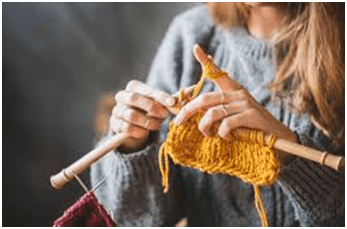
That time of the year when light breeze gently feathers across the skin and the sun cheers everyone with the loveliness of its sunshine. When the earth smells of ripeness and fullness, fruit and bounty; and the air is filled with notes of love and laughter. It is then that many sitting in their cozy nooks pick up the needles to knit comfort and warmth, stitch by stitch, for the approaching winters. Knitting has always been associated with peace, healing and pleasant childhood memories. Hand knitting is a beautiful expression of love involving the use of two or more needles to loop yarn into a series of interconnected loops in order to create a finished garment. It is a craft that has given comfort to many a generation across the globe since ages.
A brief history
Most histories of knitting place its origin somewhere in the Middle East, and from there it spread to Europe by Mediterranean trade routes, and later to the Americas with European colonization. The oldest knitted artifacts are socks from Egypt, dating from 11th century C.E. While in Europe the earliest known knitted items can be traced to the Spanish Christian Royal families who employed Muslim knitters. Several paintings from Europe portray the Virgin Mary knitting including ‘Our Lady Knitting’ by Tommaso da Modenna. There is also mention of knitting in the plays by Shakespeare that were written between 1590 and 1610. In 17th and 18th century hand knitting became an important occupation in Scottish Isles. By mid 19th century hand knitting declined due to the increasing use of mechanical knitting machines. In India, scholars do not have a fixed time period assigned to the introduction of knitting. There is no ancient word in Sanskrit for knitting. Even in Hindi language, the term for knitting is bunaai which means weaving. Textile expert Toolika Gupta is of the opinion that when knitting was introduced in India, it was instantly called bunaai for lack of better word. Therefore, the word ‘weaving’ or bunaai has been synonymous with knitting in this country.
Present scenario
The popularity of any craft has always swayed along the ongoing fashions of the eras and the changing values of the society. The 1920s saw a rise in demand for sweaters and pull-overs with statement styles being set by the likes of Prince Wales (future Edward VIII) wearing Fair Isle sweater to play golf and Coco Chanel incorporating knitwear in high fashion. It was a much sort after craft during the war years too. Again in 1950s and 1960s knitting gained huge popularity with introduction of more bright colours and styles of yarn. But the point to be noted here is that knitting as a hand craft had already lost its charm by this time. It was in mid 19th century itself that hand knitting was taken over by knitting industry and survived only as hobby. By late 20th century it further saw a decline and was rarely taught as a craft in school. With many knitting groups emerging, 21st century indeed saw a resurgence of this craft amongst Millennials but still fails to pass on the skills of this craft to Gen Z who is more occupied with virtual world errands than the real world charm.
Great gift of knitting
Hand knitting is not merely a creative leisure activity. With increasing number of mental health issues, sense of lack, broken families – knitting is a craft that can provide immense therapeutic results. The truth is that the romance of hand knitting is vanishing when it is needed the most. Hand knitting relaxes the mind, soothing its electric sparks by focusing the thoughts in the moment. It makes you still, helps gather yourself and centers your being. More so, it disciplines the faculties of mind and body, thereby increasing patience and concentration. Pain specialists have found that hand knitting changes brain chemistry, resulting in an increase in ‘feel good’ hormones (i.e. serotonin and dopamine). Interestingly, the craft of hand knitting being a binary wrapping code of knit and purl stitches, serves as one of the best brain exercises to increase I.Q. as well. Studies have also shown that knitting has helped reduce the risk of Alzheimer’s disease and dementia. The gift of hand knitting certainly lies in its healing nature. It is a craft in which sweetness is infused and calm induced. As is said –
“Sweet contents knit in my soul, in a million happy stitches”
Basics: Learn how to cast on the needle, i.e. put the yarn on the needle Learn to do a knit stitch and purl stitch Learn to cast off the live stitches And you’re ready to make that scarf for this Christmas!
There is a very popular saying that life is a stage where men and women play their parts and go. But things take a turn when the question of ‘how to play it’ comes. We need to rise and contemplate about these intricacies of life. For this we need to understand our mind, for it is the paintbrush that goes long way painting our lives.
Our mind wobbles, jumps or is at peace sometimes. The way it works and shapes, leads to the way our eyes perceive the world around. And for the world, it sees our character painted by our mind and it becomes our identity. Our character is determined by our actions and the niche of our actions lies in our mind. Mind, character, behavior, lifestyle, success, failure – all come round full circle and mind is the real game player.
In this pacing modern era, each and every person undergoes various situations. In present times, a lay mans observation is that everything touches extremity. Rich is getting richer, poor is getting poorer; success or failure both reach pinnacle; poverty or corruption, everything has reached its height. Increasing cases of depression, diseases, suicide, crime, breach and many more – all indicate that people are not able to balance their actions, their lives and basically their minds! Why was not it to this extent during our grandparents time? There are other factors too that play their part but human mind is certainly the main hidden factor that creates this imbalance.
Every human needs to have a positive mind under any circumstance to unlock the door of content, happiness and a wonderful life! It’s a blatant truth that almost 95 % people have restless minds leading to an unhappy life. Take the example of a glass of water, filled till the middle. What do you perceive? What is your reaction? Either you will say it is ‘half empty’ or ‘half filled’. This experiment is helpful in knowing how happy life you will lead based on your attitude. Ideally, a person with a sunshine approach to life should say at least there is some water in that glass!
Fundamentally a person should know two things about mind – handling and nourishing it. Finding happiness in little things of life is what positiveness is all about. Happiness is the power to reverse our mind from bad to good. Every lock has a key. Discipline of faculties, self control, meditation, going for morning walks, taking a break for a nice family vacation, appreciating the beautiful world around us, talking and sharing our experiences (thus, making ourselves feel lighter and better) – are all ways to tackle and handle our mind, but until and unless we don’t nourish it, the whole process remains incomplete. Vehicles need fuel, electronics need electricity and body needs food. Likewise, our mind needs nourishment. Reading good books, developing a hobby, healthy lifestyle, good company, positive environment, faith and hope – are some of the things we need to do to keep our minds nourished. And every person who is successful in doing this – his life is well accomplished!
We should always consider our mind ‘a gift of nature’ like a tree that has hundreds of branches and yet sprouting many more. And all we need to do is to prune it well, so that it is good enough to create a beautiful happy life.
Farmers are unhappy with the new agriculture bills
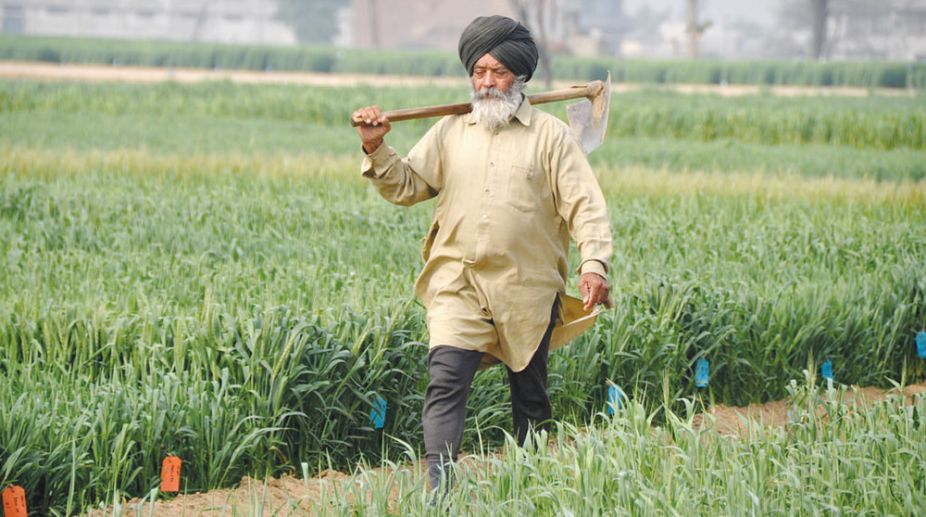
After the CAA protests, now the centre government is facing yet another major backlash. The new farm ordinances promulgated in June this year, have not gone well with the farming community, especially of Punjab and Haryana. The reforms in the agricultural markets include deregulation of farm foods from the Essential Commodities Act (ECA). Farmers are also allowed to sell their produce to the government regulated market yards (mandis) or Agricultural Produce Market Committees (APMCs), as well as to private firms outside this set up. They have also been allowed to enter into farming contracts. The government says that these bills have rid the farmers from the shackles of middleman, increased the profit margins for them, increased their bargaining power and hence a freer trade. However, the farming community refuses to accept these as pro farmer legislations and they have strong arguments to make which should not be overlooked.
The farming community believes that with the coming of private players it will be difficult to hold them accountable for any malpractice or harassment. The eventual phasing out of the Minimum Support Price (MSP) will take away the farmers safety net and the farmers already have many issues to tackle with from depleting water levels, rising input costs for farming and debts. Least government involvement in the entire process of crop procurement will snub the small and marginal farmer decreasing their bargaining power instead of increasing it. The parallel mandi system that has been allowed to be carried out along with the entry of agribusiness firms will become redundant over a period of time – handing the baton finally to the big corporations. It is to be pointed out here that although the government claims that it is trying to help the farmers by ridding them of the monopoly of APMCs, the farming community has never been entirely against the APMCs work ecosystem in the first place. Many farmers are hugely dependent on artiya system (government licensed commission agents which gives them credibility with the farmers) for loans and smooth functioning of their daily lives. Even the banks could not provide as healthy an alternative to the farmers. Secondly and more importantly if the government could assure the provision of MSP in the legislation itself, they would not have faced such protests. The problem is not the private player but the lack of legal binding of MSP in the new bill.
Here is a deeper analysis.
Small Threat v/s Big Threat
It cannot be denied that traditionally farmers have faced some problems at the hands of APMCs. However, the farmers have a collective strength as the government is answerable to them locally and nationally, which makes sure that APMCs never overreach themselves. Hence, it is a smaller threat to their progress. On the other hand, with big corporations coming in and no government involvement, the farmers will have no backup. A mutual agreement can only take place or rather hold its place if all the parties involved can exercise their strengths equally. With no strong protective measures from their democratically elected government, the farmers will definitely have a bigger threat from these corporations who have the financial power and the digital behavioral data of millions of people. Till date the American government could not completely round off Facebook founder Mark Zuckerberg for his mega company’s data malpractices that have impacted daily life and electoral decisions of people around the globe. How will the simple farmers ever round up private players and big corporations in case of any injustice?
One size does not fit all
Punjab and Haryana are states where the agitation against the new reforms is the most severe since they have higher contribution in filling the food security pool of India. Therefore the legislation needs to be flexible in its application. 34 % of wheat and 22% of rice is contributed to the nation by Punjab alone. The Punjab government too collects handsome mandi tax which is also outside the GST. This tax helps create and maintain robust infrastructure like roads connecting rural areas, mandi infrastructures, etc. It is used for the welfare of people and hence should not be done away with. By removing the fee on trade and excluding the mandis from the definition of trade areas the government is clearly incentivizing the traders. Earlier the traders came to a defined and well allocated area for trade with the farmers. Now a marginal farmer is expected to carry around huge quantities of produce directly to various bases of traders. This new provision is unviable for the farmers of Punjab and Haryana. This predicament is not as strongly applicable to other states as they have a weak APMC structure. In Bihar not even 1% of targeted wheat procurement happened at MSP in this past rabi season which ended in April this year. The overall contribution of the state in terms of produce is also lesser than Punjab and Haryana. Therefore, entry of a private player might be a good alternative in this state. Yet, without government back up or intervention no trader or private company will give a decent price for the hard labour of a farmer even in these states. The main point to be taken here is that one size or one approach does not fit all.
Why rush it through?
The APMC structure came to fore legally in 1956 in the face of famine in order to check unlawful trading. The system evolved to accommodate the changed circumstances of farmers over the years. Now when it has become an integral part of many state economies, where is the need to suddenly overturn it without a proper dialogue with the stakeholders? Why ram it through with these bills in the already troubling time of coronavirus pandemic? There was no need to issue an ordinance. Normally these ordinances are issued only as an emergency law. These have to be converted into legislation as soon as the parliament reconvenes. More importantly it needs to be highlighted that any law related to agriculture, agriculture processing and marketing is not even a subject of Union list. It is constitutionally a State subject.
The government is free to introduce reforms for the betterment of its people. Precisely, it is for this very reason the elected representatives have been sent to parliament by the people. But firstly, where is the emergency? To do it behind the façade of a pandemic is not the right way ethically and morally. Secondly, does it hint at something else too? Internationally, a new business climate is trying to emerge from the moribund economy due to the ongoing pandemic. There is a visible monopolistic behavior on the rise, with supersized deals taking place between various corporate giants who have strong access to capital market. The recent deals to boost Jio ecosystem is one such case in point. The accelerated digital transformation for these bigger corporations in turn primarily means enhanced “surveillance capitalism” making the governments across the globe more in sync with such deals since they can become the biggest buyers of this surveillance data, giving a more potential rise to ‘Cambridge Analytica’ like case. In times like this, when a new dangerous world wave is emerging do we really want private players to come in.
Even if it is just hysteria, why risk crushing the Anndatta by passing such ordinances in such a hush which might weaken the economy of states, and who knows…might also become entry point for a new East India company!
The history of Punjab unfolds this land of five rivers as the birth place of Indus Valley Civilization, the land of warriors and of-course for its gastronomy. But little is realized that it has also been the land of remarkable trade and commerce that was quite sophisticated for its time. It is the old bazaars of Punjab that testify and give a glimpse even today to this rich history and culture as we lose ourselves in the charm of its old winding alleys.
Through the history
The undivided Punjab enjoyed an advantageous geographical position on the world’s silk route. This overland route created a potential market for the agricultural and non agricultural material resources of the region. Punjab became a commercial hub and crossroad for trade across Europe, Persia, Central Asia, Deccan and Delhi. A well developed process of bills of exchange called hundi system was used for the purpose of trading by the kafilahs or caravans of merchants, pilgrims and travelers.
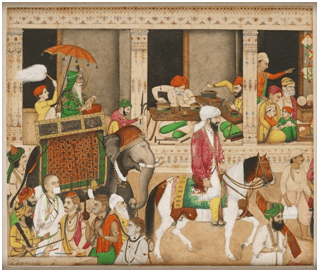
However, the location of Punjab on the famous silk route was on one hand good for the trade but on the other hand was the source of instability bringing repeated invasion. The 18th century undivided Punjab saw a low state of trade, not only because of foreign invasions but also because of the policies of various independent Sikh and Non-Sikh chiefs of Punjab. Nevertheless, the trade managed to chisel out its path through the vicissitudes of political turmoil. It is in the late 18th and early 19th century that the stability of the region restored under the powerful reign of Sher-e-Punjab Maharaja Ranjit Singh as Punjab entered its golden era.
Maharaja Ranjit Singh in the bazaar of Lahore; 19th century
With the partition of India in 1947, some of the old historic bazaars of undivided Punjab that included Multan, Lahore, Rawalpindi, Shikarpur went to the other side of Wagah border but the indelible imprint of the collective culture stayed. Within Punjab, as William Francklin puts, there was never a fixed route for trade but the most significant one lied between Amritsar to Patiala – the two cities that till date house the oldest bazaars of present day Punjab.
Amritsar to Patiala – The bazaars in the olden days!
The city of Amritsar was founded by the fourth Sikh Guru Ram Das ji in 1574 A.D. To initiate the economic activity he invited fifty-two traders from different sectors to settle here who started the first thirty-two shops in the city that was to become the grand emporium of trade in the coming times. Sugar, spice, rice, wheat, indigo, utensils and white cloth (the togas of upper class Romans and turbans of Central Asian Turks were all made of Indian white cloth) were the main items that the bazaars of Amritsar offered to the traders from other regions. The Asiatic Annual Register of 1809 mentions that Amritsar was the prominent hub of trade for shawls. Pashmina was imported from Kashmir and Tibet. Lungis and Dohar manufactured at Pakpattan, the famous ghee from Kamalia and Qabuli, ‘Nemuk Lahooree’ or salt from Lahore, turmeric from Kathua and saffron from Kashmir found market in the bazaars of Amritsar. From Persian side came the swords, horses and dry fruits.
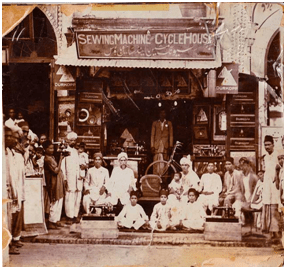
An old picture of Hall Bazaar in Amritsar
During the British Raj, Amritsar was not only trading in shawls but also carpets, and piece goods, silk and woolen cloth. Indian textile industry catered to a quarter of worlds demand and Amritsar became one of the most flourishing textile production centres. Author Gurcharan Das points out that this trade with Europeans, however, was mainly balanced with gold and silver in the balance sheet as Indians were not much interested in British goods until the Industrial Revolution of 19th century. In fact, it is during this time that the cloth and carpet trade and production in Amritsar started to decline as the machines in the west supplanted the handlooms. However, this did not alter the energy of the bazaars as the city developed expertise in the culinary niche – making it the ‘Food Capital of Punjab’ – putting it on the world map for its mouth watering cuisine.
In between Amritsar and Patiala, the ancient cities of Jalandhar and Ludhiana were the other commercial hubs. Jalandhar founded by Devasya Verma as mentioned in Vedas, was famous for its fine textiles and the Nakodar chandeli fabric which were marketed to Lahore and Kashmir through the bazaars of Amritsar. While Ludhiana founded by the chiefs of Sikander Lodhi who was at the helm of power at Delhi in 15th century, had a full-fledged bazaar popularly called Chaura Bazaar renowned for its white cloth. The bazaar got further boost during British Raj as the city became an important British cantonment.
The Patiala State was founded by Baba Ala Singh in 1763 with the foundation of Quila Mubarak or Patiala Fort. It enjoys a special place in the history of Punjab as can be observed from folklore and tradition. After the decline of Maharaja Ranjit Singhs Empire, it was the royal house of Patiala that provided patronage to the artisans and musicians of the declining empire. Similarly, they gave patronage to the members of disintegrating Mughal court at Delhi and welcomed all the silver and gold smiths, parandi (ornament) makers, jutti (shoe) makers and other artists. Eventually, the bazaar of Patiala began to develop and flourish around Quila Mubarak and became a creative hub. The Darshni Gate right outside the Quila in the bazaar became the jewelers’ souk with a Shiva temple opposite to it. While, paranda hattis andtraditional embroidery shops got established in the by-lanes webbed across.
Jump into the heart of action!
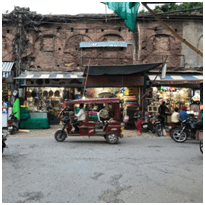
The bazaars of Punjab are as lively and bustling with energy as they were in the past. Only the wide alleys of these souks of past now look narrower in the present as we jump into the heart of action. There is chaos but also exotic vibrant charms as the architectural legacies overlook these bazaars.
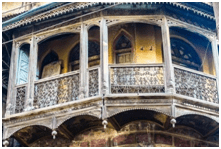
As we enter the connected labyrinth of bazaars in the old walled city of Amritsar through the Gandhi Gate (also popularly called Hall Gate) and dodge across motorbikes and rickshaws or wander across the Town hall whose architecture reminds us of the imperial era, marvel at Sikh architectural features and frescos at Quila Ahluwalia in Hall Bazaar or take a deep sigh looking at the grandeur of Ram Bagh Gate that still stands in its original form in nanakshahi brick – there is plenty to occupy the mind (and senses!).
Quila Ahluwalia in Amritsar
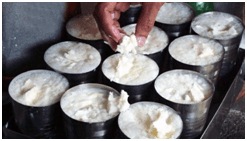
The famous lassi (buttermilk), Amritsari Kulche (a unique bread) and kulfi faluda (ice cream)at Katra Jaimal Singh Bazaar; the tongue tantalizing aam papad, pickle and papad wadia (spicy lentil balls used in curries) at Ram Bagh Bazaar; the beautiful gold jewellery at Guru Bazaar (a souk much frequented by British ladies during British Raj); exquisite textiles at Shastri Bazaar; or a walk through the newly revived Heritage street to visit Golden Temple simply transports to the olden days.
Creamy lassi at Katra Jaimal Singh Bazaar
Not to miss the Bartan Bazaar that provides market to the brass and copper utensils that are made in Amritsar which have been enlisted on the UNESCO’s list of ‘Intangible Cultural Heritage’. The curious fascinating feel of walking through these bazaars, comes from the knowledge of the fact that there is a network of ancient tunnels (some branch out from Quila Ahluwalia and Ram Bagh Palace to mention a few) underneath, above which the whole bazaar bustles every single day.
Similarly, the Chaura Bazaar in Ludhiana extending from famous colonial clock tower to the Ghas Mandi is now famous for hosiery, apparel and garments, machine parts. The World Bank ranked Ludhiana as the city with best business environment in India in 2009 and 2013. The only surviving structure from ancient period in the city is the Purana Quila or Lodhi Fort which is about twenty minutes away from Chaura Bazaar. Heading to the bazaars of Patiala, the old world charm starts much before we reach the Anardana chowk. Some of the old shops still have clearly defined Sikh architectural features like embellished parapets, chattris or domes and pilasters. These shops stand distinct and graceful next to the new fashionable facades in the market.
Busy lanes of Adalat Bazaar
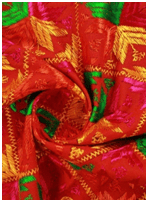
The pulsing Adalat bazaar is replete with beautiful phulkaris (folk embroidery of Punjab) and rich fabrics like silks and satins showcasing some of the finest embroideries that are done by karigars or craftsmen of Patiala, Lucknow and Kolkata. The dyers of Patiala who have been traditionally dying the turban cloth of famous Patiala Shahi Turban, in the royal state colours of soft pink and lemon, are till date running their shops in Adalat Bazaar. As we go deep into the souk, there are many offshoots to other bazaars and popular lanes.
Silk thread Phulkari
The colourful paranda (traditional silk or cotton thread hanging used as hair ornament by Punjabi women) bazaar near Quila Mubarak; the famous jutti lane near Tope Khana road in Adalat bazaar; the heat and the smell of spices in the Gur Mandi are all exotic experiences with their own enticement that these bazaars offer even today. These bazaars of Punjab are living specimens of our grand history – the thriving hubs of our culture and tradition.



 Harleen Gurunay Majithia