OPINION: Why Farmers Opposition To The New Agricultural Reforms Is Justified

Punjab farmer unions to corner Cong govt
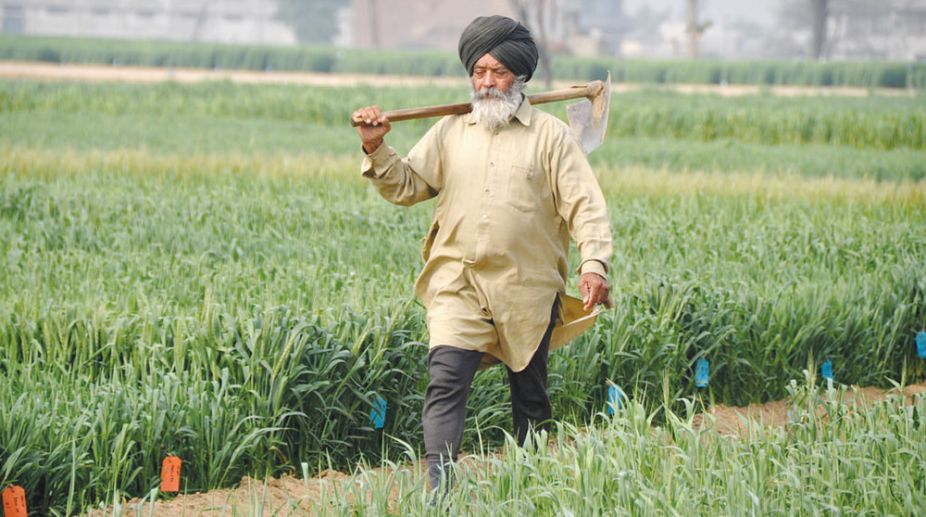
Farmers are unhappy with the new agriculture bills

After the CAA protests, now the centre government is facing yet another major backlash. The new farm ordinances promulgated in June this year, have not gone well with the farming community, especially of Punjab and Haryana. The reforms in the agricultural markets include deregulation of farm foods from the Essential Commodities Act (ECA). Farmers are also allowed to sell their produce to the government regulated market yards (mandis) or Agricultural Produce Market Committees (APMCs), as well as to private firms outside this set up. They have also been allowed to enter into farming contracts. The government says that these bills have rid the farmers from the shackles of middleman, increased the profit margins for them, increased their bargaining power and hence a freer trade. However, the farming community refuses to accept these as pro farmer legislations and they have strong arguments to make which should not be overlooked.

The farming community believes that with the coming of private players it will be difficult to hold them accountable for any malpractice or harassment. The eventual phasing out of the Minimum Support Price (MSP) will take away the farmers safety net and the farmers already have many issues to tackle with from depleting water levels, rising input costs for farming and debts. Least government involvement in the entire process of crop procurement will snub the small and marginal farmer decreasing their bargaining power instead of increasing it. The parallel mandi system that has been allowed to be carried out along with the entry of agribusiness firms will become redundant over a period of time – handing the baton finally to the big corporations. It is to be pointed out here that although the government claims that it is trying to help the farmers by ridding them of the monopoly of APMCs, the farming community has never been entirely against the APMCs work ecosystem in the first place. Many farmers are hugely dependent on artiya system (government licensed commission agents which gives them credibility with the farmers) for loans and smooth functioning of their daily lives. Even the banks could not provide as healthy an alternative to the farmers. Secondly and more importantly if the government could assure the provision of MSP in the legislation itself, they would not have faced such protests. The problem is not the private player but the lack of legal binding of MSP in the new bill.                                 

Here is a deeper analysis.

Small Threat v/s Big Threat

It cannot be denied that traditionally farmers have faced some problems at the hands of APMCs. However, the farmers have a collective strength as the government is answerable to them locally and nationally, which makes sure that APMCs never overreach themselves. Hence, it is a smaller threat to their progress. On the other hand, with big corporations coming in and no government involvement, the farmers will have no backup. A mutual agreement can only take place or rather hold its place if all the parties involved can exercise their strengths equally. With no strong protective measures from their democratically elected government, the farmers will definitely have a bigger threat from these corporations who have the financial power and the digital behavioral data of millions of people. Till date the American government could not completely round off Facebook founder Mark Zuckerberg for his mega company’s data malpractices that have impacted daily life and electoral decisions of people around the globe. How will the simple farmers ever round up private players and big corporations in case of any injustice?

One size does not fit all

Punjab and Haryana are states where the agitation against the new reforms is the most severe since they have higher contribution in filling the food security pool of India. Therefore the legislation needs to be flexible in its application. 34 % of wheat and 22% of rice is contributed to the nation by Punjab alone. The Punjab government too collects handsome mandi tax which is also outside the GST. This tax helps create and maintain robust infrastructure like roads connecting rural areas, mandi infrastructures, etc. It is used for the welfare of people and hence should not be done away with. By removing the fee on trade and excluding the mandis from the definition of trade areas the government is clearly incentivizing the traders. Earlier the traders came to a defined and well allocated area for trade with the farmers. Now a marginal farmer is expected to carry around huge quantities of produce directly to various bases of traders. This new provision is unviable for the farmers of Punjab and Haryana. This predicament is not as strongly applicable to other states as they have a weak APMC structure. In Bihar not even 1% of targeted wheat procurement happened at MSP in this past rabi season which ended in April this year. The overall contribution of the state in terms of produce is also lesser than Punjab and Haryana. Therefore, entry of a private player might be a good alternative in this state. Yet, without government back up or intervention no trader or private company will give a decent price for the hard labour of a farmer even in these states. The main point to be taken here is that one size or one approach does not fit all.

Why rush it through?

The APMC structure came to fore legally in 1956 in the face of famine in order to check unlawful trading. The system evolved to accommodate the changed circumstances of farmers over the years. Now when it has become an integral part of many state economies, where is the need to suddenly overturn it without a proper dialogue with the stakeholders? Why ram it through with these bills in the already troubling time of coronavirus pandemic? There was no need to issue an ordinance. Normally these ordinances are issued only as an emergency law. These have to be converted into legislation as soon as the parliament reconvenes. More importantly it needs to be highlighted that any law related to agriculture, agriculture processing and marketing is not even a subject of Union list. It is constitutionally a State subject.

The government is free to introduce reforms for the betterment of its people. Precisely, it is for this very reason the elected representatives have been sent to parliament by the people. But firstly, where is the emergency? To do it behind the façade of a pandemic is not the right way ethically and morally. Secondly, does it hint at something else too? Internationally, a new business climate is trying to emerge from the moribund economy due to the ongoing pandemic. There is a visible monopolistic behavior on the rise, with supersized deals taking place between various corporate giants who have strong access to capital market. The recent deals to boost Jio ecosystem is one such case in point. The accelerated digital transformation for these bigger corporations in turn primarily means enhanced “surveillance capitalism” making the governments across the globe more in sync with such deals since they can become the biggest buyers of this surveillance data, giving a more potential rise to ‘Cambridge Analytica’ like case. In times like this, when a new dangerous world wave is emerging do we really want private players to come in.

Even if it is just hysteria, why risk crushing the Anndatta by passing such ordinances in such a hush which might weaken the economy of states, and who knows…might also become entry point for a new East India company!
SUNDAY FEATURE: The Old Bazaars of Punjab

The history of Punjab unfolds this land of five rivers as the birth place of Indus Valley Civilization, the land of warriors and of-course for its gastronomy. But little is realized that it has also been the land of remarkable trade and commerce that was quite sophisticated for its time. It is the old bazaars of Punjab that testify and give a glimpse even today to this rich history and culture as we lose ourselves in the charm of its old winding alleys.

Through the history

The undivided Punjab enjoyed an advantageous geographical position on the world’s silk route. This overland route created a potential market for the agricultural and non agricultural material resources of the region. Punjab became a commercial hub and crossroad for trade across Europe, Persia, Central Asia, Deccan and Delhi. A well developed process of bills of exchange called hundi system was used for the purpose of trading by the kafilahs or caravans of merchants, pilgrims and travelers.

However, the location of Punjab on the famous silk route was on one hand good for the trade but on the other hand was the source of instability bringing repeated invasion. The 18th century undivided Punjab  saw a low state of trade, not only because of foreign invasions but also because of the policies of various independent Sikh and Non-Sikh chiefs of Punjab. Nevertheless, the trade managed to chisel out its path through the vicissitudes of political turmoil. It is in the late 18th and early 19th century that the stability of the region restored under the powerful reign of Sher-e-Punjab Maharaja Ranjit Singh as Punjab entered its golden era.

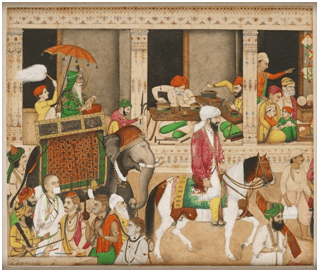
Maharaja Ranjit Singh in the bazaar of Lahore; 19th century

With the partition of India in 1947, some of the old historic bazaars of undivided Punjab that included Multan, Lahore, Rawalpindi, Shikarpur went to the other side of Wagah border but the indelible imprint of the collective culture stayed. Within Punjab, as William Francklin puts, there was never a fixed route for trade but the most significant one lied between Amritsar to Patiala – the two cities that till date house the oldest bazaars of present day Punjab.

Amritsar to Patiala – The bazaars in the olden days!

The city of Amritsar was founded by the fourth Sikh Guru Ram Das ji in 1574 A.D. To initiate the economic activity he invited fifty-two traders from different sectors to settle here who started the first thirty-two shops in the city that was to become the grand emporium of trade in the coming times. Sugar, spice, rice, wheat, indigo, utensils and white cloth (the togas of upper class Romans and turbans of Central Asian Turks were all made of Indian white cloth) were the main items that the bazaars of Amritsar offered to the traders from other regions. The Asiatic Annual Register of 1809 mentions that Amritsar was the prominent hub of trade for shawls. Pashmina was imported from Kashmir and Tibet. Lungis and Dohar manufactured at Pakpattan, the famous ghee from Kamalia and Qabuli, ‘Nemuk Lahooree’ or salt from Lahore, turmeric from Kathua and saffron from Kashmir found market in the bazaars of Amritsar. From Persian side came the swords, horses and dry fruits.

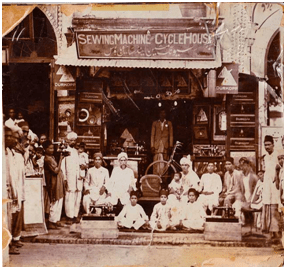
An old picture of Hall Bazaar in Amritsar

During the British Raj, Amritsar was not only trading in shawls but also carpets, and piece goods, silk and woolen cloth. Indian textile industry catered to a quarter of worlds demand and Amritsar became one of the most flourishing textile production centres. Author Gurcharan Das points out that this trade with Europeans, however, was mainly balanced with gold and silver in the balance sheet as Indians were not much interested in British goods until the Industrial Revolution of 19th century. In fact, it is during this time that the cloth and carpet trade and production in Amritsar started to decline as the machines in the west supplanted the handlooms. However, this did not alter the energy of the bazaars as the city developed expertise in the culinary niche – making it the ‘Food Capital of Punjab’ – putting it on the world map for its mouth watering cuisine.

In between Amritsar and Patiala, the ancient cities of Jalandhar and Ludhiana were the other commercial hubs. Jalandhar founded by Devasya Verma as mentioned in Vedas, was famous for its fine textiles and the Nakodar chandeli fabric which were marketed to Lahore and Kashmir through the bazaars of Amritsar. While Ludhiana founded by the chiefs of Sikander Lodhi who was at the helm of power at Delhi in 15th century, had a full-fledged bazaar popularly called Chaura Bazaar renowned for its white cloth. The bazaar got further boost during British Raj as the city became an important British cantonment.

The Patiala State was founded by Baba Ala Singh in 1763 with the foundation of Quila Mubarak or Patiala Fort. It enjoys a special place in the history of Punjab as can be observed from folklore and tradition. After the decline of Maharaja Ranjit Singhs Empire, it was the royal house of Patiala that provided patronage to the artisans and musicians of the declining empire. Similarly, they gave patronage to the members of disintegrating Mughal court at Delhi and welcomed all the silver and gold smiths, parandi (ornament) makers, jutti  (shoe) makers and other artists. Eventually, the bazaar of Patiala began to develop and flourish around Quila Mubarak and became a creative hub. The Darshni Gate right outside the Quila in the bazaar became the jewelers’ souk with a Shiva temple opposite to it. While, paranda hattis andtraditional embroidery shops got established in the by-lanes webbed across.

Jump into the heart of action!

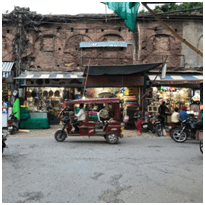
The bazaars of Punjab are as lively and bustling with energy as they were in the past. Only the wide alleys of these souks of past now look narrower in the present as we jump into the heart of action. There is chaos but also exotic vibrant charms as the architectural legacies overlook these bazaars.

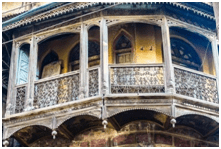
As we enter the connected labyrinth of bazaars in the old walled city of Amritsar through the Gandhi Gate (also popularly called Hall Gate) and dodge across motorbikes and rickshaws or wander across the Town hall whose architecture reminds us of the imperial era, marvel at Sikh architectural features and frescos at Quila Ahluwalia in Hall Bazaar or take a deep sigh looking at the grandeur of Ram Bagh Gate that still stands in its original form in nanakshahi brick – there is plenty to occupy the mind (and senses!).

Quila Ahluwalia in Amritsar

The famous lassi (buttermilk), Amritsari Kulche (a unique bread) and kulfi faluda (ice cream)at Katra Jaimal Singh Bazaar; the tongue tantalizing aam papad, pickle and papad wadia (spicy lentil balls used in curries) at Ram Bagh Bazaar; the beautiful gold jewellery at Guru Bazaar (a souk much frequented by British ladies during British Raj); exquisite textiles at Shastri Bazaar; or a walk through the newly revived Heritage street to visit Golden Temple simply transports to the olden days.

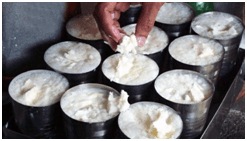
Creamy lassi at Katra Jaimal Singh Bazaar

 Not to miss the Bartan Bazaar that provides market to the brass and copper utensils that are made in Amritsar which have been enlisted on the UNESCO’s list of ‘Intangible Cultural Heritage’. The curious fascinating feel of walking through these bazaars, comes from the knowledge of the fact that there is a network of ancient tunnels (some branch out from Quila Ahluwalia and Ram Bagh Palace to mention a few) underneath, above which the whole bazaar bustles every single day.

Similarly, the Chaura Bazaar in Ludhiana extending from famous colonial clock tower to the Ghas Mandi is now famous for hosiery, apparel and garments, machine parts. The World Bank ranked Ludhiana as the city with best business environment in India in 2009 and 2013. The only surviving structure from ancient period in the city is the Purana Quila or Lodhi Fort which is about twenty minutes away from Chaura Bazaar. Heading to the bazaars of Patiala, the old world charm starts much before we reach the Anardana chowk. Some of the old shops still have clearly defined Sikh architectural features like embellished parapets, chattris or domes and pilasters. These shops stand distinct and graceful next to the new fashionable facades in the market.

Busy lanes of Adalat Bazaar

 The pulsing Adalat bazaar is replete with beautiful phulkaris (folk embroidery of Punjab) and rich fabrics like silks and satins showcasing some of the finest embroideries that are done by karigars or craftsmen of Patiala, Lucknow and Kolkata. The dyers of Patiala who have been traditionally dying the turban cloth of famous Patiala Shahi Turban, in the royal state colours of soft pink and lemon, are till date running their shops in Adalat Bazaar. As we go deep into the souk, there are many offshoots to other bazaars and popular lanes.

Silk thread Phulkari

The colourful paranda (traditional silk or cotton thread hanging used as hair ornament by Punjabi women) bazaar near Quila Mubarak; the famous jutti lane near Tope Khana road in Adalat bazaar; the heat and the smell of spices in the Gur Mandi are all exotic experiences with their own enticement that these bazaars offer even today. These bazaars of Punjab are living specimens of our grand history – the thriving hubs of our culture and tradition.

Published in The Post India on 22.9.2020

NUGGETS of LIFE: Amid bits and bytes, listen to the eco beep

There is a whirlwind around each one of us; a whirlwind of 0s and 1s with a thundering vortex of beeps and bangs

My daughter would not eat without watching her favourite cartoon show. On days she would not sleep without listening to the soft symphonies of nature with birds chirping in the background that I often play on my mobile. When she dozes off and I turn off that music, a guilt stings me. We have transitioned from a generation who would casually listen to the birds singing in our gardens and backyards while doing our daily chores to a generation that experiences it in a secondhand recorded way of bits and bytes.

The truth is inspite of having all the luxuries and comforts of technology, the next generation of humankind is perhaps the farthest from the more powerful and real luxury and charm of pristine nature. There is a whirlwind around each one of us; a whirlwind of 0s and 1s with a thundering vortex of beeps and bangs. The problem is that we’ve got so used to it that we do not realize we are not immune to it. Somewhere along that road, we have stopped listening to the eco beep – the symptoms and alarm of our degrading environment. More so, we have also stopped addressing the vitality of our own entire being.

Rather than working on our inner being, we are working too much on the outside on our planet. Little more done and we will come crashing down with a grim scenario already predicted by the central agencies with no groundwater in the next 20 years in many regions. With species facing extinction, mountains blasted and dissected for commercial projects and catastrophic global warming, the time for words is over now. It’s reached a point where substantial action is required at each individual level.

We have been bitten and bitten quite badly by the snake of rampant consumerism whose venom irrespective of our efforts is spreading slowly. If we introspect our daily habits it comes down to a two-step capsule – use and discard. Every time a new phone comes in the market, everyone wants to devour the latest and discard the well functioning old one. Interestingly, these tech friendly fads have market strategies as their bedrock that drives us to decide unconsciously in almost all the matters. It is an issue we do not want to address. Today, we are relying so much on technology from tracking the time to the security of our bank accounts, that there are too many loose ends that can be threatening.

However, there is another truth we can’t dust of, and that is, we can’t really give up our mobile phones and technology in its various forms. It cannot be done certainly! The tech-world and science have a pertinent place in history as well as in making our daily lives better. They deserve credit, but the point is atleast we should be cautious of becoming the new Don Quixote – living a life of illusion, self created problems and staying stuck in a virtual world bereft of reality.

Alteast, we should not forget the art of living in the moment and connecting with nature. Perhaps, we have forgotten precisely that but time is passing by and a cure is needed because at the end would we have the luxury of an author to correct the faults of his first draft?

I don’t think so.

Published in Hindustan Times on 27.9.2019

OPINION: A Full Circle View of Post Covid-19 World

We are too close to the details to see the bigger picture, while the large volume of prevalent information becomes merely reporatge.

The coronavirus pandemic is still unfolding but one thing is sure that there will be dramatic and strategic shifts while the world walks through the dark valley. But is this simply a new wave – an upgradation, or are we in the eye of the storm? An abyss of concentrated power which will eventually create a furore in all the areas of human existence from business world to geopolitics, social life to the virtual world – each inseparably linked to the other…

The Universe is always expanding and collapsing. And then from a collapse it re – expands. This is the process of creation and history stands witness to this fact that the world pattern similarly has always been that of ebb and flow. There are peaceful times and then there are times when the pressure of events sets in. We are too close to the details to see the bigger picture, while the large volume of prevalent information becomes merely reportage. In the face of such events, the course of history changes and coronavirus pandemic is one such event.

The trends likely to rise in the post covid-19 world are much discernable now, in the second half of 2020. It is not merely a new wave leading to the next level, where Khyber knife makes way for sophisticated weaponry. There is a new business climate trying to emerge from a moribund economy. The businesses have accelerated their digital transformation but they are far from overcoming all their problems. The onset of monopolistic behavior with supersized deals taking place, thereby concentrating bigger corporates who already have had a better access to the capital market, clearly forecast a much tougher time for smaller businesses to come out of the freeze. An accelerated digital transformation for these bigger corporations in turn primarily means enhanced “surveillance capitalism”, making the  states more in sync with such deals since it would be in their interest– giving a more potential rise to ‘Cambridge Analytica’ like cases.

The governments across the globe have already begun their shift to self sufficiency and wider digital reach amongst its citizens. Coronavirus pandemic has further led to increased use of digital tools of organic marketing, whereby the global population is also more receptive to such approach than ever before.  With state initiatives tapping social media platforms for outreach, there is now higher risk for general population to not being able to decipher the targeted content contextualized into their lives through such platforms. Now, with globalization being threatened and weak global entities leading to political compromises, there is less gainful competition and lesser choices, and higher threat to social and mental well being.

It is to be pointed out here that in this scenario a new trend is also subtly taking birth. It cannot be ignored that globalization is threatened but it is also certain that it cannot come to an abrupt halt. On the other hand nations have begun developing notable individual cultures and started their self sufficient projections but it is a long way to go before this complete self sufficiency comes into existence for all nations, if at all. But somewhere in between this wide disparity in projections and the reality, a consolidation of political and economic power has begun, making use of this fall out. A trend giving birth to oligopolies and endangering democracies.

If this becomes the eye of the storm, to point out metaphorically – the coriolis effect would further bellow the ‘epidemic of despair’. There is already much less discussion on mental health despite a spike in number of suicides in this pandemic. Unlike the business world, no model or strategy is being devised to curb this angle of the crisis. If this is left unattended it can lead to higher discontent, rage, unrest and depression leading to faulty decision making capability at individual level; and as a collective society. Even if the world comes out with a vaccine by the end of this year and there is a respite in the panic and anxiety due to covid-19, will mass vaccination be possible? Especially for the under privileged in any country – with World Health Organization’s “Solidarity Call to Action” not being supported by majority governments and pharmaceutical companies across the globe – it is long way to go.

At this time when the repercussions of the pandemic are still emerging, there can be no conclusions but only questions. There is much needed to be read in between the lines, than what the eyes can read. There will certainly be higher incidents of social and economic partiality and polarizations with a serious mental health crisis looming above.

 A safety buffer zone should be created by smaller businesses by coming together forming a pool which is not just fiscal in nature but also source of creativity and innovation to preserve their long term growth. It is not how quickly new technologies are adopted but how dedicated you are in maintaining the customer loyalty. As the world is going through the current storm, it is important to be aware and resist any autocratic surveillance empowered by artificial intelligence in the virtual world. And last but not the least, if the sense of fear arising from your current circumstances is imprisoning the mind – remember to first survive and then thrive, because future is always a notion and not reality that is created partly by circumstances and partly by faith in yourself. And faith, can move mountains as they say!

SUNDAY FEATURE: Go Creative, Go Green

It is time to step up into a conscious living but with a twist of creativity.

Nature is an oasis of tranquility, beauty and rejuvenation. It has given us uncountable gifts from its healing power to everyday goods that make our life comfortable. But what have humans done in return? Humans have looted the very life source and plundered the dexterous working mechanism of our Mother Earth.

 It is certainly the time to get into action for bringing a change. There are many remedial measures being suggested but until and unless we accept these from within us, they would hardly serve as a solution to the countless environmental catastrophes! The time for discussions is over. It is time to step up into a conscious living but with a twist of creativity.

We generally underestimate the power of creativity that can make something out of nothing. Creativity can turn a simple idea into a great novelty and a dull school routine into the best thing an educationist ever did!

It is creativity that subtly forces out of the box thinking (and to be scientifically precise it is the right side of our brain responsible for this magical skill!), thereby directing our mind into unexplored positivity and possibility. We need it in our daily attitudes, approaches, theories, campaigns and initiatives of saving environment. John Cleese, the famous English actor and comedian, had once rightly remarked that creativity is not a talent but the way of operating.

 So here are some creative, fascinating, quirky and imaginative ‘trash to treasure’ converting formulas that each and every one of us should adopt – each day every day!

  • THEME IT ECO STYLE!

When it comes to styling your rooms and lounges, the primary concern is to create an aura that is de-stressing and comforting. One thing is for sure – nothing can calm down the nerve better than the relaxing vibe of a natural theme. And what’s better about it is that you can go the DIY way, making it easy on the pocket as well as the environment. There are a plethora of things you can do with almost any disposed off material. The empty jam jars can be used for decorating your outdoors with scented candles. You can also plant some flowers in a group of bulbs and hang them on a tree in your garden or in your balcony. You can also make miniatures, photo frames and showpieces from old newspapers and cardboard for your childs room. From crockery and bathroom fittings, wooden boxes, wine bottles, tins, old magazines to the embroidery on your suits and sarees – everything can be used to do up your place in the most economical and eco friendly way.

  • THE PLASTIC MANIA

The plastic bags and products are the worst enemies of nature all across the globe! So learn to unleash your vibrant and creative mind to make use of plastic products that would otherwise only add to the garbage heaps. The noted designer Clement had introduced stylish tote bags, made by weaving several plastic bags together, in the fashion industry long time back. Well, why can’t we make DIY products from plastic bags then? We can certainly make beautiful baskets, door mats and attractive African styled ‘Inkuku’ chairs by weaving plastic bags in a basic framework – just needs a little patience!

  • THE ECO-FASHION

With increasing awareness regarding environment degradation due to unchecked human activity, the world of fashion has apparently changed its gear for the better. From international designers like Stella McCartney, Mark Liu to Desi designers and fashionistas like Sonam kapoor and Dia Mirza, all have been zealously promoting eco-friendly collections. So the next time you buy a fabric – say no to synthetics and polyester and give a thumbs up to pure fabrics like organic silk and khadi. Ask your local boutiques to use and promote organic dyes instead of chemical dyes and bleaches. Try to mix and match things. You can make a really cool outfit from your old military or floral bedsheets! It not only encourages the creativity in you but also helps in keeping the environment greener.

  • THE MYSTICAL SOUP!

Before allowing good food to spoil, allow your belly to enjoy it. As they say, wasting food is like saving every dime to have a ride of hell. So even if you have leftovers and vegetables in your refrigerator, who are getting tired and old but haven’t yet given up – cook them into a delicious soup right away! You can use leftovers like herbs, pieces of meat, bits of bread, pieces of cheese and lots more. Use your magical mind to explore various recipes of soups from different leftovers or waste ingredients that have been still stocked up in your cooling box since the last weekend! It would be quite an experience.

It is time to do our bit, at individual and collective level. The GO-CREATIVE, GO-GREEN approach does not tax your resources in any way, rather encourages the creativity in you. Martin Luther King Jr. once said, “Almost always the creative dedicated minority has made the world better.” Only this time the minority should turn into the world majority.

Published in The Post India (thepostindia.co.in) on 1/8/2020

NUGGETS of LIFE: Living the virtual life, courtesy corona

At last, humankind has realised how vulnerable it can be

“It’s interesting how Corona has shifted the entire world to live virtually in real time and finally the revelation has happened”, I said looking up from my phone.

“Throw some light…”- came the swift inquisition from my husband who had his eyes racing across the news bulletin for quite sometime until now.

I went on rambling in my mind about how human lifestyles had become too fast paced to be lived efficiently and without a warm sense of hygge (coziness) as Danish would put it.

Until, came Corona and everything got bombarded in a lockdown – but for everyone’s good I’d say.

My husband now looked up at me sensing the silence and awaiting me to illustrate my statement. So I began.

“You see earlier the spicy gossips that happened over cards and kitty parties have now switched over to online Ludo games and WhatsApp groups. Similarly, when poori-chana were made on Sundays – close friends were invited over brunch, or the home baked cakes were shared over tea or coffee. Now they are shared on Instagram.”

“Now this sharing doesn’t lead to any olfactory satisfaction amongst friends in reality but since these turn into popular internet trends, so the poor things have to keep up with it – whether they like it or not”, I went on.

“Hmm, so it’s like I shared my cake now you share yours”, added my husband as my kiddo raced across.

“And just look at the change in the lives of all the kids! How happy they are with their virtual classes but they miss their friends terribly and evenings turn into drama parties for parents to handle. Yet there are many children across the country that do not have access to computers and sadly are also missing out the meal provided at school. There will be consequences of schools being shut down for so long.”

My husband looked thoughtful now. “You’re right! It won’t be easy to bridge the gap of holistic learning and of course deal the screen addiction.”

“Yes, so…there are also people posting pictures of working from home – on their laptops with a cup of black tea by their side – telling tales of how happy they are of this new trend of virtual offices across IT sector, while others are complaining how monotonous it is to work from home!”

“And by the way everyone has started to read newspapers online these days. It’s all getting digitized and techy I tell you. At least many trees would be saved.”

My husband shook his head in disagreement: “Dearest you would be flooded with fake news and targeted with algorithms if all you do is read from online portals. It would be no good for our society to completely do away with traditional print media.”

“But in between what is the big revelation?” he asked in a serious tone zooming back to my first statement.

I turned to look him full in the face – “At last humankind has realized how vulnerable it can be.”

Published in Hindustan Times on 11/6/2020